Cundinamarca Department
The Cundinamarca department has Bogotá as its capital. The 116 municipalities of Cundinamarca are distributed in 15 provinces, within the Andean region.
The department of Cundinamarca is located in the center of the country, in the Andean region. It has a total of 116 municipalities, distributed in 15 provinces. Its capital is Bogotá, which is also the capital of Colombia.
It borders to the north with Boyacá, to the east with Casanare, to the south with Meta and Huila, and to the west with Tolima and Caldas.
It also surrounds the capital district of Bogotá, except for the southeastern border.
With approximately 2,800,000 inhabitants (excluding Bogotá) in 2018, it is the third most populous department — behind Antioquia and Valle del Cauca — and with 111 inhabitants/km², the seventh most densely populated, behind San Andrés and Providencia, Atlántico, Quindío, Risaralda, Valle del Cauca, and Caldas.
It was created on August 5, 1886 under the terms of the 1886 Constitution.
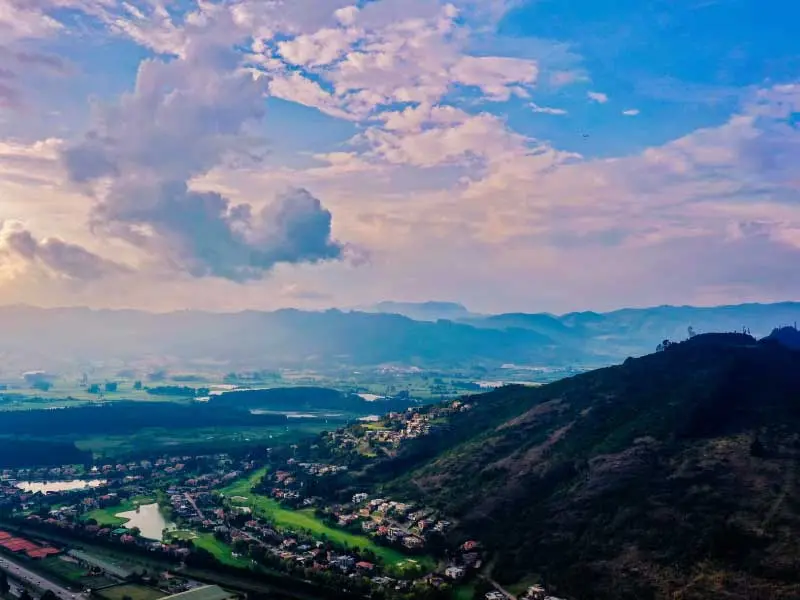
IMPORTANT DATA
CAPITAL
BOGOTÁ
INHABITANTS
2,804,238
GENTILICIO
CUNDINAMARQUÉS
SURFACE AREA
24,210 km²
GOVERNOR
Jorge Emilio Rey Ángel
OFFICIAL WEBSITE
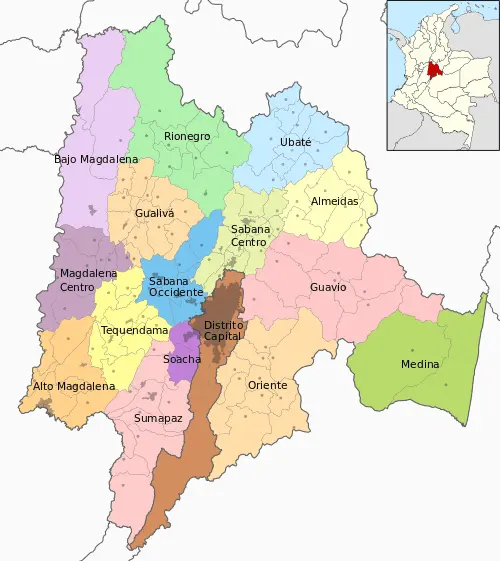
MAP OF THE DEPARTMENT OF CUNDINAMARCA
The following municipalities of Cundinamarca are located on the map according to their respective regions or provinces:
PROVINCES OF CUNDINAMARCA
The department of Cundinamarca has a total of 116 municipalities, distributed in 15 provinces, which are:
- Almeidas
- Alto Magdalena
- Bajo Magdalena
- Gualivá
- Guavio
- Magdalena Centro
- Medina
- Oriente
- Rionegro
- Sabana Centro
- Sabana Occidente
- Soacha
- Sumapaz
- Tequendama
- Ubaté
MUNICIPALITIES OF CUNDINAMARCA
The following 116 municipalities of Cundinamarca in list includes the province to which it belongs:
| Municipality Name | Province |
| Chocontá | Almeidas |
| Machetá | Almeidas |
| Manta | Almeidas |
| Sesquilé | Almeidas |
| Suesca | Almeidas |
| Tibirita | Almeidas |
| Villapinzón | Almeidas |
See All Municipalities of Cundinamarca
MUNICIPALITIES OF CUNDINAMARCA NEAR BOGOTA
There are 22 municipalities of Cundinamarca that, due to their proximity to the capital of the country, are considered part of the Metropolitan Area of Bogotá.
The Metropolitan Area of Bogotá has not yet been legally recognized, however, these municipalities of Cundinamarca are part of The Bogotá Savannah and some have already been reached by urban projects of the capital, integrating them partially into the capital.
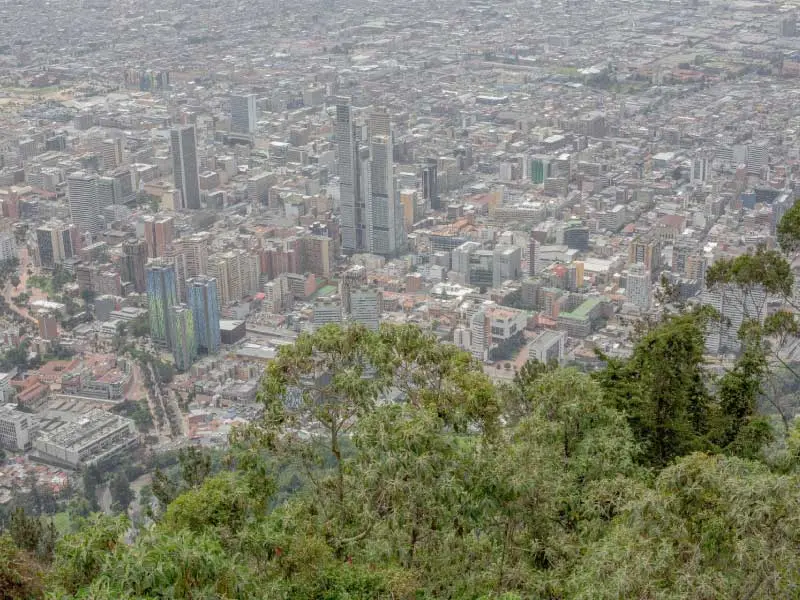
Following is the list of municipios of Cundinamarca closest to Bogotá:
- Bojacá
- Cajicá
- Chía
- Cogua
- Cota
- El Rosal
- Facatativá
- Funza
- Gachancipá
- La Calera
- Madrid
- Mosquera
- Nemocón
- Soacha
- Sibaté
- Sopó
- Subachoque
- Tabio
- Tenjo
- Tocancipá
- Zipacón
- Zipaquirá
HISTORY
During the pre-Hispanic period, it was enabled by indigenous people belonging to the Chibcha family, especially the Muiscas, surrounded by Panches, Muzos, and Colimas. The main expeditionary was the conquistador Gonzalo Jiménez de Quesada, who arrived in the area in 1537.
In the independence, this area was the center of the Independence Cry on July 20, 1810. Since 1886, it was constituted as a department.
RELIEF
This area of the country is mostly mountainous topography, with elevations of over 4500 msnm. Like the Sumapaz, Chingaza, Choachí, Guerrero, and Nevado páramos, the high El rayo and Oseras; the Bogotá savannah, the Ubaté valley, the Palomas range, the San Antonio, Sargento, Los Farallones, Montecristo, Quipile, El Tablazo, Ubalá, and other ranges.
CLIMATE
The department has a privileged climate due to its geographical location, which determines that it has lands in the tropical convergence zone or equatorial climates, which in turn causes the climate to be tropical and rainy. It also presents altitude climate or thermal floors.
ECONOMY
The department’s economy revolves around agricultural and livestock activities, it is the first national producer of sugarcane and barley, in mining it stands out for its coal reserves, gem salt, livestock production, it is unbeatable in terms of beef for fattening and milk, sheep, pigs, laying hens, broilers. There is also fishing, beekeeping, and breeding of minor species. Tourism is another factor of wealth for the department.
HYDROGRAPHY
It is bathed by the Magdalena, Sumapaz, Negro, dry, Bogotá, Guavio, Guacavía, Humea, etc. rivers. It is worth noting that the department has lakes and reservoirs of great importance for the nation, such as the Cucunubá, Suesca, Pedro Palo, La Herrera, Ubalá, and Guatavita lakes, and the Chingaza, Neusea, Muña, Guavio, La Regadera, and Sisga reservoirs.
NATURAL RESERVES
In the department, there are two natural reserves:
- Chingaza National Natural Park
- Sumapaz National Natural Park
CUNDINAMARCA HYMN
Lyrics:
Albero Perico
Music: Hernando Rivera Páez
CHORUS
With a feverish accent, let us sing
of this land its triumphant hymn
and to your glorious history, let us sing
so that you never forget your name (Bis).
I
You were the seat of heroic tribes
Cundinamarca, a land without equal,
that labored on your rocks
and forged your immortal destiny. (Bis).
II
In your fields, there is sun and hope;
you are an empire of rich heritage,
to Colombia, you give men of grace
who cover it with faith and dignity. (Bis).
See the municipalities of Cundinamarca
See the Andean Region of Colombia
You may also be interested in