Department of Norte de Santander
North of Santander whose capital is Cúcuta, is located in the northeast of the country, in the Andean region. It is an important economic axis of the country.
The department of Norte de Santander, whose capital is Cúcuta, is located in the northeastern part of the country, in the Andean region.
It borders to the north and east with Venezuela, to the south with Boyacá, and to the west with Santander and Cesar.
This department is located between 6° 58′ and 9° 18′ of north latitude and 72° 03′ and 73°35′ of west longitude from Greenwich and an altitude of 320 msnm.
Norte de Santander is full of history, since in Cúcuta the consolidation of the current Colombia and Venezuela took place, giving rise to the Gran Colombia on October 3, 1821.
The department was created in the Gran Colombia. Its natural resources and geographical location have made it an important economic and commercial axis of the country.
IMPORTANT DATA
CAPITAL
SAN JOSÉ DE CÚCUTA
POPULATION
1’391.366
GENTILICIO
NORTESANTANDEREANO
SURFACE AREA
21648 km²
GOVERNOR
William Villamizar Laguado
OFFICIAL WEBSITE
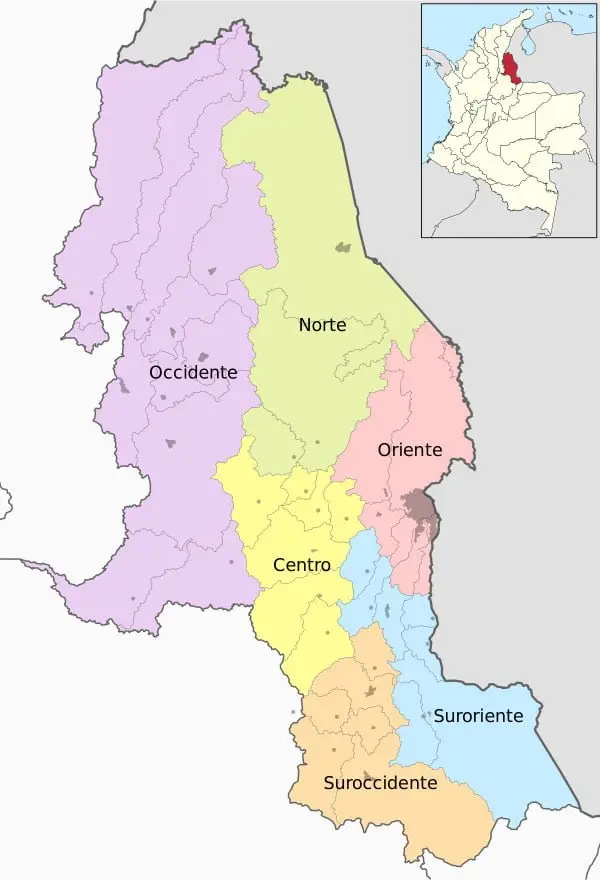
SUBREGIONES DE NORTE DE SANTANDER
The department of Norte de Santander has a total of 40 municipalities, distributed in 6 subregions, which are:
- Norte
- Occidente
- Metropolitana
- Centro
- Sur-occidente
- Sur-oriente
MUNICIPIOS DE NORTE DE SANTANDER
The following 40 municipalities of Norte de Santander in list including the subregion to which it belongs:
| Flag | Subregion |
| Arboledas | Center |
| Cucutilla | Center |
| Gramalote | Center |
| Lourdes | Center |
| Salazar de Las Palmas | Center |
| Santiago | Center |
| Villa Caro | Center |
| Cúcuta | Metropolitan |
| El Zulia | Metropolitan |
| Los Patios | Metropolitan |
| Puerto Santander | Metropolitan |
| San Cayetano | Metropolitan |
| Villa del Rosario | Metropolitan |
| Bucarasica | North |
| El Tarra | North |
| Sardinata | North |
| Tibú | North |
| Ábrego | West |
| Cáchira | West |
| Convención | West |
| El Carmen | West |
| Hacarí | West |
| La Esperanza | West |
| La Playa de Belén | West |
| Ocaña | West |
| San Calixto | West |
| Teorama | West |
| Cácota | South-west |
| Chitagá | South-west |
| Mutiscua | South-west |
| Pamplona | South-west |
| Pamplonita | South-west |
| Santo Domingo de Silos | South-west |
| Bochalema | South-east |
| Chinácota | South-east |
| Durania | South-east |
| Herrán | South-east |
| Labateca | South-east |
HISTORY
This area was inhabited by Chibcha Chitarero Indians and Motilones descendants of the Caribs. The first conqueror to set foot in this territory was the German Ambrosio Alfínger in 1530, who was killed by the indigenous people. In 1535, Pedro de Usúa and Otún Velasco founded Chinacota.
The conquest and population process occurred as such, only in 1549 with Usúa, who founded Pamplona.
July 14, 1910, it was created as a department.
RELIEF
It is a rugged terrain and is crossed by the Eastern Cordillera with extensions such as the Ocaña table, from the cordillera the San Turbán knot and the Catatumbo Valley slope are detached, which occupies 87% of the territory, has slopes of diverse inclination, difficult access heights and deep canyons.
The flat area occupies 13% of the extension of the department, presents low hills, valley bottoms of the Zulia, Pamplona and Táchira rivers, among others. The Bobalí hill, the Tibú sierra and the Cachira and Tamú páramos.
HYDROLOGY
It is composed mainly of the Catatumbo and the very caudalous affluents, in addition to finding smaller rivers such as Sardinata, Zulia Margua and Cubugón with their respective affluents.
CLIMATE
Half of the department is warm, while the remaining surface constitutes a medium climate and a last part a cold and páramo climate, the average temperatures are 30°C in the hot valleys of Zulia and Catarumbo and 3°C in the páramos.
This climatic variety has also determined agricultural productivity.
ECONOMY
It is a coffee region, in the department also plantain, yuca, potato, arracacha, corn, wheat, sugarcane, rice, citrus fruits, onion, fique are cultivated.
Tobacco is another product of the area. They have livestock production and in relation to cattle, 92% of the animals are for breeding and fattening, while 8% is used in milk production.
This department is also rich in mineral resources, has gold, copper, iron, uranium, aluminum, silver, barite, and fluorite. There are oil deposits in Tibú.
NATURAL RESERVES
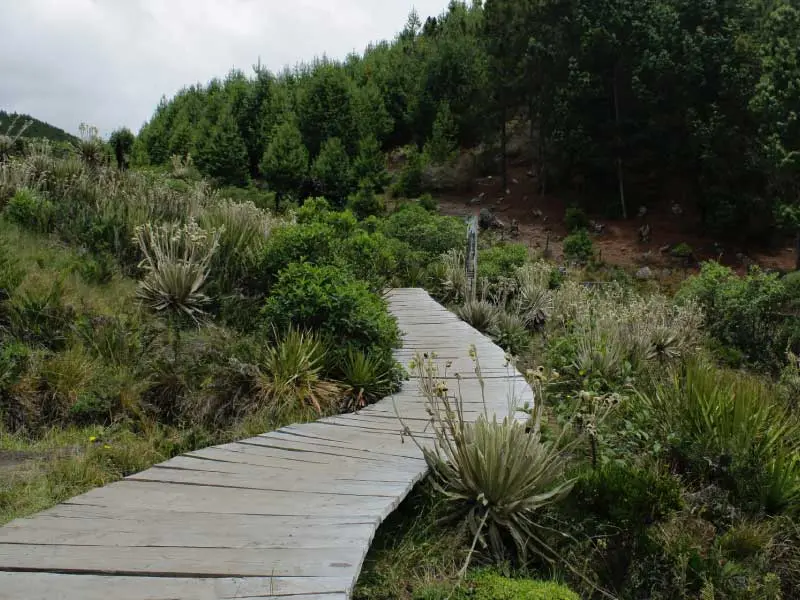
This department offers a multiplicity of natural landscapes and sites impregnated with history and resources, ranging from high mountains and lakes. The Natural Monument of the Estoraques stands out
HYMN
Lyrics: Teodoro Gutiérrez Calderón
Music: José Rozo Contreras
CHORUS
Brave sons of the North,
let us sing with our soul;
life for glory,
glory for the homeland!
The homeland, the homeland, the homeland.
I
In our village,
the man of laws,
without kings or viceroy
formed his proud being.
If our glories are his
and if he made us great
across the Andes
let us shout ¡Santander!
II
Bolívar, whose genius
gave us his spark
the mark left here
by his horse.
The land is our gold,
peace is our goal,
war is our dream
in search of the laurel (bis).
III
We are great in all,
oh noble austere race
that cares for its flag,
language, history, and cross
let no one take a single inch
of our land
as long as the sun gives us its light in the sky! (bis).
IV
We will give everything for you,
Colombia, in your right:
Here is our chest
and inside our heart.
The mother who cries for us…
the daughter who loves us…
Let us march, for the epic canyon calls us!
See The Andean Region of Colombia
You may also be interested in