Quindío Department
Antioquia is located in the center-west of the country, in the Andean region. Its capital is Armenia. It belongs to the coffee axis and to the Paisa region.
The Quindío Department is located in the center-west of the country, in the Andean Region. Its capital is Armenia. It belongs to the coffee axis and the Paisa region.
It borders Risaralda to the north, Tolima to the east, and Valle del Cauca to the west.
Located between 4°04′ and 4°44′ north latitude and 75°24′ and 75°52′ west longitude from Greenwich.
It is the second least extensive department in Colombia, surpassed only by San Andrés and Providencia.
In Quindío, the National Natural Park Los Nevados, the National Park of Agricultural Culture, and the renowned Coffee Park are located.
IMPORTANT DATA
CAPITAL
ARMENIA
POPULATION
574,960
GENTILICIO
QUINDIANO
SURFACE AREA
1845 km²
GOVERNOR
Juan Miguel Galvis Bedoya
OFFICIAL WEBSITE
Map of the Quindío Department
Below are the municipalities of Quindío located on the map:
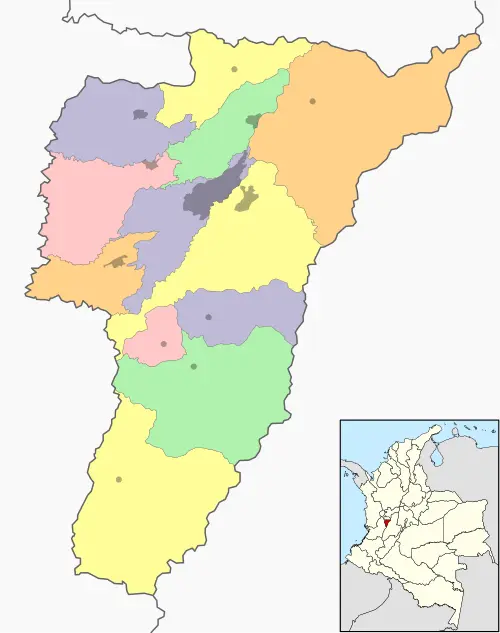
Map by: Wikimedia Commons / CC BY-SA
SUBREGIONS OF THE QUINDÍO DEPARTMENT
The department is divided into 5 subregions, which are:
- Capital
- Cordillerana
- Fría
- Norte
- Valle
MUNICIPALITIES OF THE QUINDÍO DEPARTMENT
The Quindío department has 12 municipalities listed below, grouped in their respective subregion:
Capital
- Armenia
- Buenavista
- Calarcá
Cordillerana
- Córdoba
- Génova
- Pijao
Fría
- Finlandia
- Palermo
Norte
- Circasia
Valle
- La Tebaida
- Montenegro
- Quimbaya
HISTORY
The conquistadors arrived in Quindío in 1539. First was Jorge Robledo and then Badillo and Cesar. Gold attracted colonizers and later the guacas in the indigenous burials from which it was said there was gold.
In the Quindío region, there were indigenous people mainly the Quimbayas, this group was characterized because their culture was very artistic, they were excellent goldsmiths, weavers of blankets and ceramists, we can know this thanks to the fact that today we can see these valuable findings found in their tombs.
The Quindío region was also inhabited by other indigenous tribes such as the Ansermas, Carrapas, Paucuras, Pijaos and Pozos; according to archaeological studies it is supposed that there were approximately more than 80 important caciques throughout and across this beautiful region.
Later, during the 19th century, the Antioquian colonization began and the mining society became an agricultural society.
RELIEVE
This area corresponds to the western slope of the Central Cordillera from its summits to the margins of the La Vieja River; in the relief of the Quindío region, flat areas are not appreciated and we can say that its soils are very fertile, rich in minerals thanks to the eruptions of the snow-capped volcanoes of Tolima and Ruiz.
Among the heights, the Páramo Chili and the Nevado del Quindío stand out and between the Quindío and La Vieja rivers.
One of the highest elevations is the Nevado del Quindío, with a maximum height of 4750 meters above sea level.
HIDROGRAFÍA
The department is bathed by many rivers, streams and quebradas and for this reason its hydrographic network is composed of the La Vieja River basin, this fluvial network receives the waters of the entire region through two basins, the Quindío and the Barragán.
CLIMA
It has a temperature of 20 degrees centigrade. The climates range from paramo to warm, so a medium temperature prevails.
ECONOMÍA
Coffee occupies the largest cultivated area and for this reason it produces 27% of the total national amount. In the upper part of the Cordillera there is a strip of cold climate crops.
Livestock and mining also play an important role here. It also has incentives for industry and the development of commercial centers.
The industry stands out in this industry with products such as agricultural tools and implements, metal furniture and construction accessories, clothing, food and beverages.
RESERVAS NATURALES
It has a white mountain, the Nevado del Quindío is part of the mountains that make up the National Park of the Nevados.
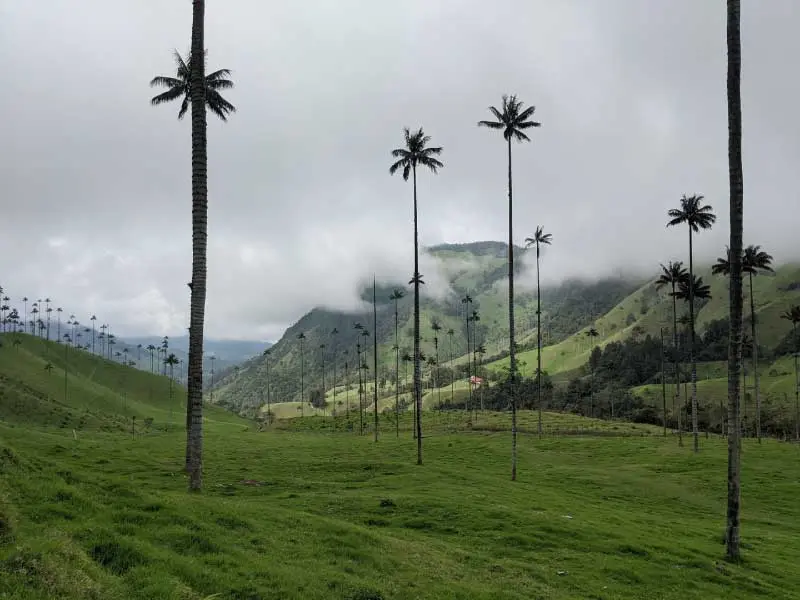
In the department, the Cócora valley is also located, this constitutes one of the most beautiful Colombian corners of forests and meadows, where the Wax Palm is observed. The Tebaida is another place of great beauty and was named as "The Tropical Eden of Quindío".
HIMNO
Lyrics:
Jorge Robledo Ortiz
Music: Luis Uribe Bueno
CHORUS
Hail land of pioneers
and of muleteers and of sun.
Hail caste of the grandfather
who sowed his heart
I
By old trails of Caldas
with the orchid as a coat of arms
Antioquia traveled barefoot
and the miracle bloomed
II
Guaduales where my old people
saw their illusion grow,
and among tiples and coffee plants
they taught us about God.
III
Blessed Quindío land
where patriarchal faith
and the reflections of the axe
opened our heritage.
You may also be interested in