Department of Córdoba
All information about the Córdoba department in the Caribbean region of Colombia. Municipalities, geography, economy, anthem, and much more.
The department of Córdoba is located in the north of Colombia, in the Caribbean region. Its capital is Montería, which was initially called San Jerónimo de Buenavista.
It borders the Atlantic Ocean to the north, Sucre and Bolívar to the east, and Antioquia to the south and west.
Its astronomical position is between 7°23′ and 9°23′ of north latitude and 74°52′ and 76°32′ of western longitude.
Its name comes from a tribute to José María Córdoba, a national hero who fought for Colombia's independence.
IMPORTANT DATA
CAPITAL
MONTERÍA
POPULATION
1’788.648
GENTILICIO
CORDOBÉS
SURFACE AREA
23.980 km²
GOVERNOR
Erasmo Elías Zuleta Bechara
OFFICIAL WEBSITE
Map of the Department of Córdoba
Here are the municipalities of Córdoba located on the map:
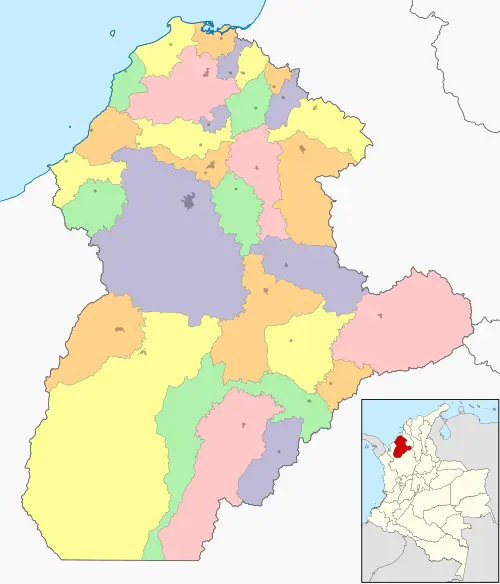
Map by: Wikimedia Commons / CC BY-SA
SUBREGIONS OF THE DEPARTMENT OF CÓRDOBA
The department of Córdoba has 7 subregions, which are:
- Alto Sinú
- Bajo Sinú
- Center
- Costanera
- Medio Sinú
- Sabanas
- San Jorge
MUNICIPALITIES OF THE DEPARTMENT OF CÓRDOBA
The department of Córdoba has 30 municipalities listed below with their respective subregion:
Alto Sinú
- Tíerralta
- Valencia
Bajo Sinú
- Chimá
- Cotorra
- Lorica
- Momil
- Purísima
Center
- Montería
Costanera
- Canalete
- Las Córdobas
- Moñitos
- Puerto Escondido
- San Antero
- San Bernardo del Viento
Medio Sinú
- Cereté
- Ciénaga de Oro
- San Carlos
- San Pelayo
Sabanas
- Chinú
- Sahagún
- San Andrés de Sotavento
- Tuchín
San Jorge
- Ayapel
- Buenavista
- La Apartada
- Montelíbano
- Planeta Rica
- Pueblo Nuevo
- Puerto Libertador
- San José de Uré
HISTORY
During the pre-Hispanic period, it was inhabited by indigenous Zenú people (Finzeppnu, Panzenu, and Cenufana) belonging to the Caribe family.
The first expeditionary was the conquistador Rodrigo de Bastidas, who arrived in the area in 1501; later, Martín Fernández de Enciso traveled along the Sinú River.
The territory was consolidated in 1951 when it declared its independence from the department of Bolivar.
RELIEVE
This area of the country is divided into two parts, a mountainous and a flat one; in the first, elevations of over 3000 msnm such as the Abibe, San Jerónimo and Ayapel ridges; the Marrucucú, Naranjal, Mutatá, Las Mulas, Las Cuchillas, Cisnatá and San Antonio hills; The Avisperos Paramo; The Níspero Hills, The Quesesas and Mata vaca and the Carrizal and Quimarí highlands.
On the coast, the following coastal accidents stand out:
- Arboletes points
- Bolivar
- Mestizos
- Buenos Aires
- The Ensenadas de la Rada
- The Cispatá Bay
- The Morrosquillo Gulf
- The Llanos mouths
- Tinajones
- Zaragoza
- The Fuerte Island
- The Tortuguilla Island
HIDROGRAFÍA
It is a privileged department in terms of water sources, as it is bathed by the Sinú, San Jorge and Canalete rivers, the most important and abundant in the area.
Other rivers that run through the department's territory are: Verde, Esmeralda, Manso and Salvajina; also important are the marshes, among which stand out: Grande de Lorica, Ayapel and Betancí.
CLIMA
The Córdoba department has its own climate, although in general terms it can be classified as dry tropical and humid tropical.
ECONOMÍA
In the Córdoba department, agriculture stands out with crops such as corn, rice, sorghum, cotton, sesame, bean, plantain, cassava, yam, coconut, sugarcane, and cacao.
However, the region's economic tradition is cattle ranching, especially Pardo Suizo, Romo Sinuano, and Cebú cattle.
As for mining, the reserves of ferroníquel, limestone, coal, iron, natural gas, quartz sand, lead, chromium, etc. stand out.
The fishing production is very good, supplying families from the riverbanks and several markets.
RESERVAS NATURALES
The Córdoba department has a natural reserve: the Paramillo National Natural Park.
HIMNO
Lyrics:
Rafael Grandeth Valverde
Music: Miguel Dechamps Perea
CHORUS
Cordoban flag
unfurl triumphantly!
The troops of your soil
acclaim you ceaselessly.
And the Sinuana woman
radiant and noble
binds you with a rich shield
engraved in freedom!
I
Bizarre paladins
let us continue in the fight!
Let us march to the summit
that rises at the edge.
The peoples that do not fight
do not have a future.
II
Today we are responsible
for our good or evil.
We are born to a life,
of free…. Liberty!
With you, on the anvil!
With you, until we triumph!
III
The soul of the homeland
embraces in fervor.
It is Córdoba that emerges
from the sacred banner
to bring us, as an offering,
its genius and its valor!
IV
Abibe and San Jerónimo!
Mountain, sky and sea!
Indomitable titans
that, to the sound of liberty
outline the epic of
work and peace!
V
Titans also were
those of yesterday
who, clearing shadows
of forests in a throng
poured into the furrows
the sweet music!
VI
May envy and resentment never germinate again.
As children of Colombia
may their heart
be the altar where our love's flame
is inflamed.
VII
Fertile, immense valley!…
Heraldic Sinú
that carries in your waves
to the blue Caribbean
the voice of free peoples
by virtue's blows!
VIII
The noble postulates
that forge our ideal
are forces that repudiate
vice and impiety
The summit is progress
that we are going to scale!…
IX
Preoccupied in the struggle
under the burning sun
there will be no foreign power
that eclipses that union,
the union that we swore yesterday
before the Fatherland and God.
X
Up, Cordobeses!
Up to fight!
Granados, heredades
and a thousand furrows
prelude the greatness
of our future.
XI
Your cry Montería
of just rebellion
was the cry of ardent passion
that the illustrious man carved:
Pass of Victors!
Arms at Discretion!
You may also be interested in